.png)
Forcing air through molten iron ignites a violent reaction. Carbon and silicon combust. Impurities burn off, oxidize, and rise, forming slag: a molten, frothing layer of waste floating on the surface.
In a few minutes, the metal is transformed. Brittle pig iron becomes steel: strong, weldable, and flexible enough to shape into rails, girders, and hulls.
More than a century ago, this was the breakthrough technology that made steel cheap enough to lay railroads, raise skyscrapers, and build fleets of ships. Andrew Carnegie built an empire on it. His partner Henry Phipps turned that fortune into a family office and eventually, one of the first venture capital firms. He named the firm for the process that made it all possible: Bessemer.
Venture capital was born from the invention of steel. Its fortunes have always been tied to the materials that build the physical economy.
Materials science is the engine of innovation that gives physical form to engineers’ dreams. Metals are foundational: malleable enough to be shaped into infinite forms, conductive enough to serve as the basis for the electronics and computing industries. Yet despite their importance, the core methods underpinning metal production have not significantly changed in over a century. We now have the tools to reimagine modern metal production from the ground up. The opportunity is both enormous and overlooked.
THE PROBLEM
Since its earliest days, civilization has been shaped by humanity's ability to harness metals. The early discovery of metals enabled human thriving, forged empires, and shaped eras named after the metals that enabled them: the Iron Age and the Bronze Age.
For millennia, people have forged metals with fire. While equipment and techniques have improved along the way, this core process itself is mostly unchanged. Smelting, refining, and separation still depend on heat and pressure from burning fossil fuels. These are processes built for scale, not for precision. These are energy-hungry, emissions-heavy, and tied to centralized infrastructure.
Their cost is measured not only in wasted energy, but in rigidity. Blast furnaces must run continuously. Refineries are fixed to their geography. Supply chains stretch across continents. The system is efficient only at scale, and when it never stops moving.
This roughness and imprecision of fossil-based heat limits the quality of the resulting metal products. Combustion heat cannot be applied precisely – it radiates, pools, and moves according to the dynamics of the furnace rather than the needs of the material. Different parts of a melting material reach different temperatures, cool at different rates, and interact unevenly with surrounding gases. The chemistry varies from batch to batch; steelmakers still "rely on experience and trials" to manage swings in elements like copper, chromium, and nickel, because conventional methods can't reliably predict what will come out of a given heat. What comes out must be graded and sorted, rather than designed and perfected.
Centuries of engineering have made these processes more reliable, but not more precise – because precision was never the goal. They were built for volume, for heat, for the brute transformation of ore into metal at scale, and supply chains stretched across the globe.
The world they were designed for no longer exists.
Metals are now strategic resources, shaping every layer of the modern economy: batteries, chips, magnets, motors, and the grids that connect them. Yet their production remains fragile. It is geographically concentrated, slow to adapt, and expensive to shift inputs and outputs. The world’s industrial base is not geared for the specificity and flexibility that the modern economy demands.
THE OPPORTUNITY: THE METALS STACK IS BEING REWRITTEN
Entrepreneurs and engineers are reimagining every step in the metals value chain. From exploration to refining to recycling, the shift is consistent: away from heat and bulk processing, toward precision and control. Each step in metals production is becoming faster and more specific, enabling a more flexible, distributed, and resilient industrial base.
That shift compounds across each step of production. Controlling how material is transformed – not just that it is transformed – makes possible metals with tighter tolerances, more consistent properties, and entirely new performance characteristics. Processes can run at smaller scales, with lower capital intensity and greater flexibility in inputs. Adjustments happen in real time, rather than designing around steady-state operation.
In practice, that means metals engineered for the job: harder, lighter, sharper, more resistant to failure and corrosion than anything legacy methods can produce. Knives, drills, and machining tools that make more precise cuts and stay sharper for longer, improving economics from manufacturing to drilling. Engines that can run hotter and more fuel efficient. Steel hulls for undersea craft that can dive deeper without buckling. Alloys that can withstand the corrosive force of the sea, space, and re-entry without breaking down.
The tools enabling this are already here. They work in isolation, but are more effective in combination. Artificial intelligence is accelerating materials discovery and enabling real-time process control. Sensors are making previously invisible dynamics measurable. New separation methods are increasing selectivity at the molecular level. And forms of energy beyond combustion – electricity, electrochemistry, lasers, electromagnetic radiation – allow energy to be applied exactly where and how it is needed.
What then changes is not just how metals are made, but what can be made altogether.

Exploration
Exploration is the search for ore deposits, the process of finding where the Earth concentrates valuable elements. For most of history, exploration relied on field-based methods that were slow and relied on manual observation and sampling. Geologists conducted surface mapping and geophysical surveys using magnetometers and gravimeters, collected drill core samples at various intervals, and inferred subsurface geology from the limited point measurements. Data was spatially sparse and subject to instrumental noise and sampling bias. Each new discovery resulted from long, slow iterative testing and pattern recognition by expert geologists.
The physics of exploration haven’t changed, but the tools have. We can now use satellites, drones, and other remote sensing tools to capture orders of magnitude more data with much higher precision and global coverage. Ground-based instruments capture terabytes of data on density, conductivity, seismology, and magnetism. Assessments that once took months of sampling can now be modeled before a drill ever turns.
Each survey produces millions of data points that must be correlated across dimensions: spatial, chemical, temporal. Historically this work was done manually, with geologists comparing patterns and building maps by hand. Now, AI systems can integrate remote-sensing data, geological history, and known mineral physics to predict likely deposits with far greater accuracy.
Modeling enables exploration to move from trial-and-error to simulation-first targeting. Companies can test hundreds of geological hypotheses in silico before committing physical resources. The cost of discovery falls, the time between surveys shortens, and exploration expands to areas once written off as uneconomic.
Exploration is becoming a computational discipline, replacing intuition with inference and expanding our ability to comprehend the world beneath our feet.
Extraction and Separation
Extraction begins with impact: ore is drilled, crushed, and milled to separate target metals from unwanted rock. Subsequent processing converts geological material into a concentrated, industrial feedstock. For more than a century, the governing principle has been the same: optimize the amount of crushed rock that is pushed through a processing system.
This approach is a blunt filter that leaves valuable minerals in the ground or in scrap heaps. Conventional extraction prioritizes bulk conversion over selectivity, using chemicals or heat. Hydrometallurgical processes use strong acids or alkaline solvents to dissolve metals out of rock and into liquid solution. Pyrometallurgical routes use high-temperature to separate the desired metals from ore. Everything above a pH or temperature filter is recovered, everything below is discarded. The result is binary output streams: concentrated metal products alongside large-volume tailings and gaseous emissions. Energy, water, and reagents are consumed at high rates because everything is processed – not just the target metal.
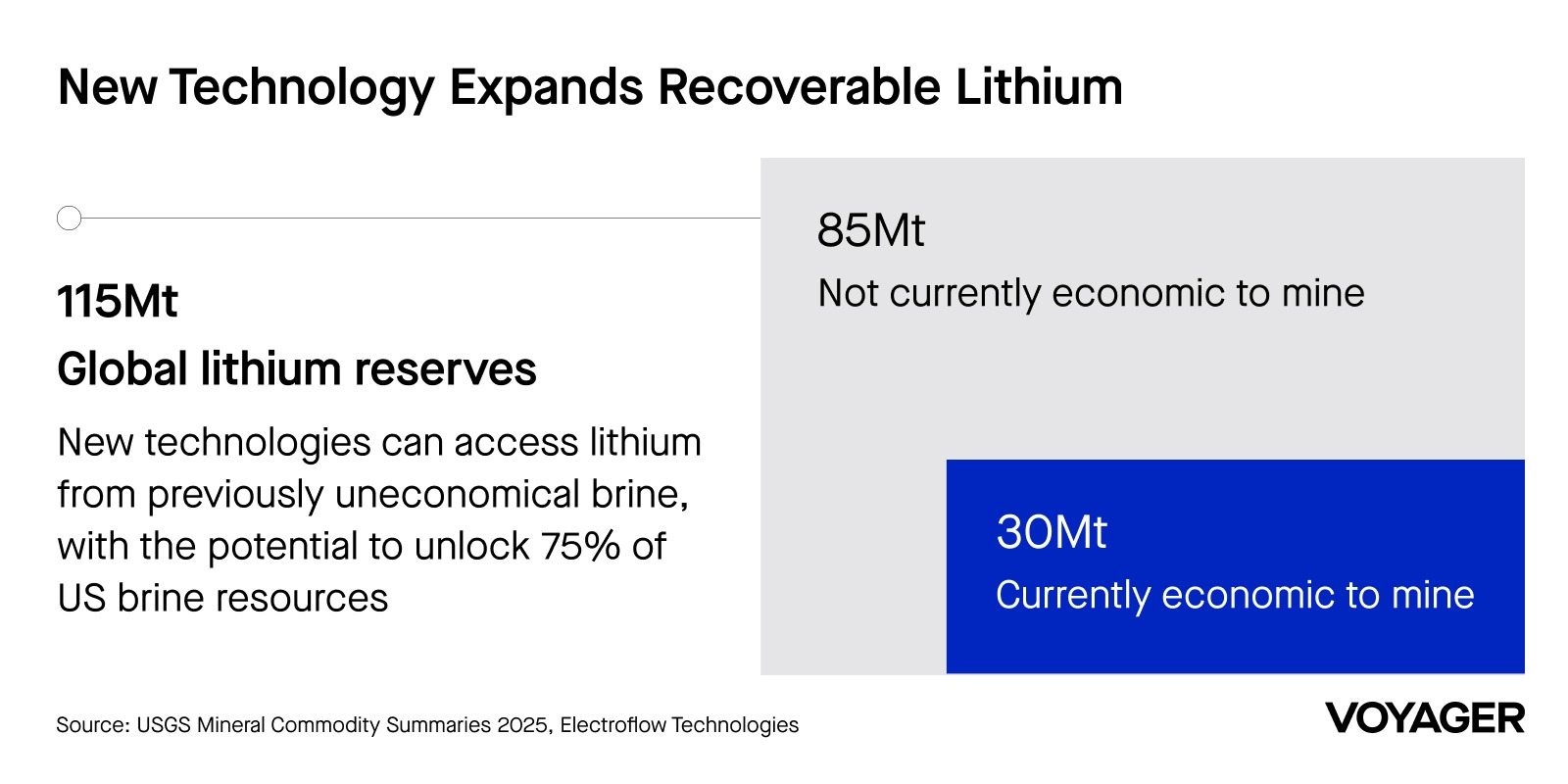
New methods are beginning to create efficiency through selectivity. Reactions can now be targeted with precise filters of specific molecules and energy beams, rather than separated with combustion and harsh chemistry. Proteins and catalysts can isolate specific metals within ore, taking what’s desired and leaving the rest untouched. Electrochemical systems can recover dissolved metals from brines and tailings using just enough electrical energy to move the metals of interest and leave the rest. New, in-situ recovery processes narrow the amount of material required to free metals from ore.
This new precision alters the economics – and geographies – of extraction.
When extraction chemistry can be tailored to specific ore mineralogy and grade, by deposit, or even by truckload, low-grade deposits become viable. The economic advantage shifts to producers with the capacity to process most efficiently, with real-time operational control, and the flexibility to use different feedstocks and output different products. Nimbleness wins over scale. Value creation depends less on how much a producer can process, and more on how efficiently a producer can process.

Refining
Advances in refining metals previously relied on more: more force, more heat, more energy. Bessemer proved that metals transformation could be accelerated by force, that air and intense heat could blast impurities out of metal faster and better. It worked, and we never looked back.
Heat from combustion works, but knows nothing of restraint. Blast furnaces and smelters are brute force tools that degrade the microstructure of material, undermining metal’s hardness and strength. Combustion heats unevenly, causing some material transformations to overcook or undercook, leading to brittleness and cracks.
The processes for refining metals are now being redesigned, free from the constraints of combustion. This opens a world of new opportunities for efficiency, perfection, optimization, and cost savings. Electricity is a precision tool. In time, it can be controlled to the millisecond; in energy, to the millivolt; and spatially, to the nanometer or the molecule. Electricity can be directed into whatever shape is most useful to accomplish a material transformation: X-rays, lasers, ultrasound, microwaves, targeted heat, electrical current. Nothing melts. Nothing explodes. No unwanted side reactions occur.
The same process that once relied on combustion now runs on feedback. Sensors monitor a material as it forms, measuring voltage, acidity, flow. Computer systems can adjust the refining process in real-time. Chemical processes are now dynamic, steered by data.
Metal production can now be perfected inside the reaction rather than after it. Metals can be made more pure in the first pass, co-products recovered rather than discarded, and alloys formed directly from solution. Refining stops being a cleanup act and becomes the first creative gesture.
Alloying and Application
Alloying is the science of mixing metals to create desired properties. It’s the process of shaping what a metal can be: hard or malleable, magnetic or stable, conductive or resistive. Every combination is a sentence written in atoms, a statement about what the world needs and what materials must exist to make it.
For most of history, this language was spoken experimentally. Metallurgists mixed and melted, testing combinations one by one. Progress came through intuition and repetition, through accidents that proved useful and patterns that became repetitive. The field moved slowly because the possibilities were nearly infinite – there are more potential alloys than there are stars in the galaxy. Predicting the result of combining dozens of factors quickly hits a combinatorial explosion, a design space that is far too complex for humans to navigate alone.
That limit is being challenged. Artificially intelligent computational programs can now explore the design landscape faster than any laboratory can. Machine learning can predict the behavior and state changes of materials, model materials’ performance under heat or stress, and identify promising recipes that are unlikely to be found by trial and error.
The new, AI-informed approach to materials science is already reshaping what metals can do. Alloys that withstand more heat, allowing engines to run more efficiently. Ceramics that store thermal energy without cracking. Materials that are light enough for flight but stable enough for orbit. Engineers are gaining the capability to program directly into materials the qualities they want, without having to accept the trade-offs they don’t.
Advanced computation enables optimization not just within a single step of material formation, but across the entire process of creation: formulating a material, designing a machine, and fabricating finished parts. The distinction between these stages is dissolving, as engineers gain more control over each. A motor casing or turbine blade can be computationally designed with geometry and materials properties solved simultaneously; performance and composition can be defined in the same model.
The performance of an alloy is defined by the elemental materials in the alloy, the pattern of how those atoms are arranged. This microstructure directly leads to properties like hardness, brittleness, strength and density. Every alloy ever made in history is imperfect because engineers could not control the microstructure precisely. This is now changing. To form alloys with more perfect microscopic structures, new technologies can make tiny metal particles that are 100 times smaller and packed more densely. Using focused energy beams instead of fossil heat allows for just enough energy to be delivered to hit the threshold for merging metals to create an alloy, without the excessive heat that distorts microstructure. These and other approaches are giving engineers programmer-level control over materials, replacing the rough techniques and guesswork of blast furnaces and acid baths. This control translates directly into materials that are more consistent, better performing, and less overbuilt; processes that use less energy and require less capital.
Recovery and Recycling
Every industrial age inherits the waste of the one before it. Tailings, slag, discarded electronics. For most of history, these materials were written off as the necessary byproducts of progress.
Recovery seeks to close that gap: to treat waste as a resource rather than a burden, and to prevent its creation in the first place by redesigning refining processes from first principles. It is fundamentally cheaper to start refining from a material that has already been refined once, rather than starting from raw ore.
This means separation more cleanly and at finer scales: batteries disassembled and dissolved into solution, magnets and alloys separated into basic elements. The same electrochemical and biological tools that are being used to extract net-new metals from ores can now also recover metal that has already been formed into products. Proteins can be used as highly specific filters to pull valuable materials like rare earth metals out of used batteries. Electrochemical gradients can be used to efficiently separate metals according to their properties.
In this light, the mine and the scrap yard begin to look similar. Both are sources of atoms waiting to be reorganized.
The implications extend beyond supply. When materials can be reclaimed efficiently, design itself changes. Products can be built with recovery in mind: joints and coatings chosen for reversibility, compositions that can be separated cleanly rather than destroyed in recycling. Circularity stops being an aspirational idea and instead becomes a design criteria.
What emerges is a quieter form of abundance. Metals don’t need to be infinitely abundant to be infinitely useful. The future of growth lies not only in discovering new resources but in learning to reconstitute the ones already in circulation, and to recover value in what was previously treated as waste.
WHY THIS MATTERS
Metals shape what can be built, how energy moves, how tall buildings can be, how fast people can travel. Metal properties define our access to space, the skies, the ocean, information. Every data center, wind turbine, computer chip and electric vehicle is a feat of metallurgy. Improving how metals are made will continue to open new possibilities for human achievement.
This evolution is not only technological, but also social and political – it redraws the boundaries of industry and policy. If production no longer depends on massive furnaces and mines in developing countries, the geography of production begins to flatten. Countries once defined by mineral wealth or cheap labor can compete through knowledge and design. Industrial capacity migrates from extraction pits to sites of intelligence: labs, process systems, data models.
Capital, too, will reorganize. Value creation moves upstream, toward the systems that govern reaction and feedback. Competitive advantage belongs to those who can integrate material science, computation, and energy at once – to see manufacturing not as an endpoint, but as an information problem. Supply chains shorten. Waste turns into inventory. Production starts to behave like software: iterative, distributed, self-correcting.
The deeper consequence is cultural. A civilization is defined by the materials it can build with. Bronze made weapons; steel made cities; semiconductors made networks. Each expansion in material capability rewrote what was possible. The technologies emerging in metals now are not just more efficient – they’re more expressive, farther reaching. They open the design landscape for more powerful chips, new kinds of sensors, and entirely new ways of thinking about and using energy, materials and machines. They allow ideas to be expressed in ever more sophisticated and powerful forms. They make the physical world newly writable.
.jpg)